Introduction
The latest wave of phishing campaigns demonstrates a subtle yet effective shift in attacker tactics. By leveraging invisible Unicode characters, adversaries can embed malicious content that remains invisible to the human eye while evading automated security controls. This development underscores the need for security teams to reassess detection logic that assumes visible text correlates with intent.
What Happened
Recent observations confirm that threat actors have adopted an ASCII smuggling technique in their phishing emails. The core of the approach involves inserting non‑printing Unicode characters into URLs or lure text. To a casual reviewer, the email appears benign; to a filter that parses only printable ASCII, the malicious payload slips through unnoticed.
Technical Details
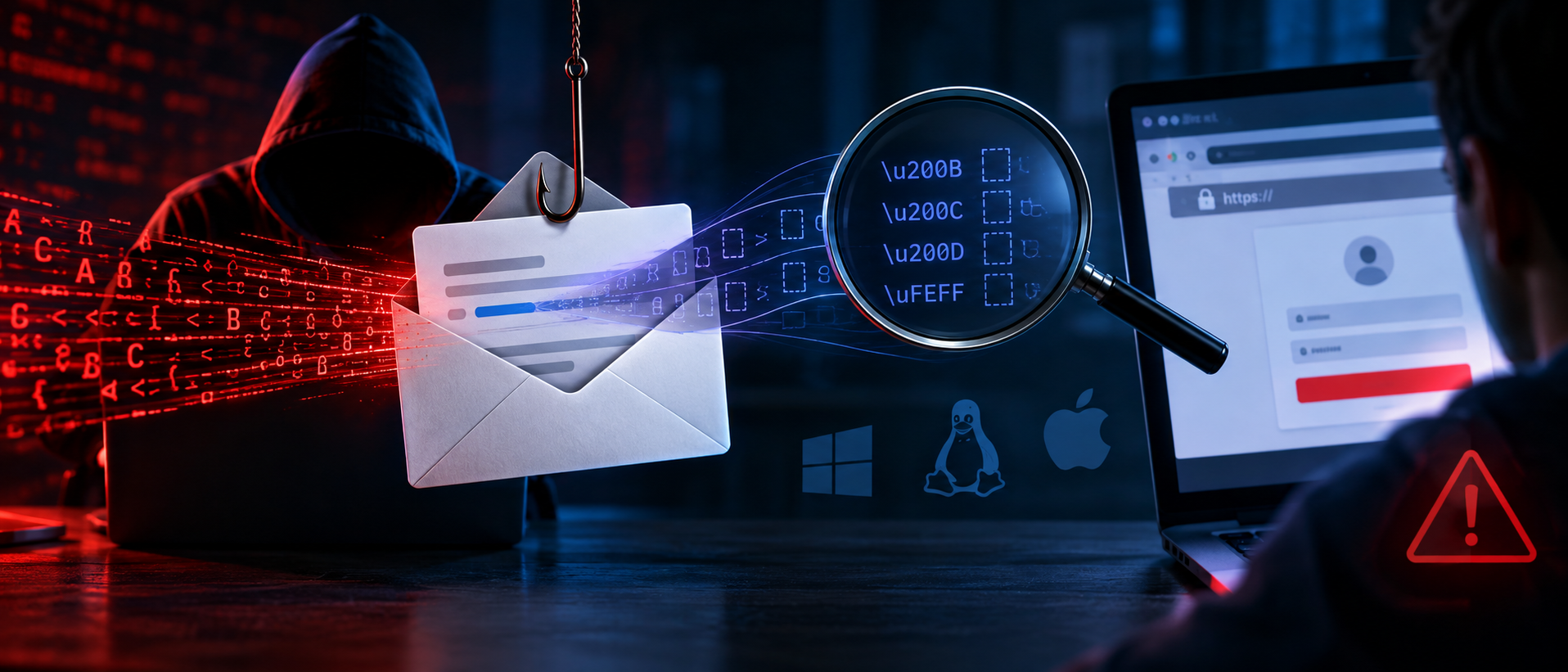
ASCII smuggling exploits the disparity between how email clients render text and how security appliances parse it. Attackers insert zero‑width spaces (U+200B), zero‑width non‑joiners (U+200C), or other invisible code points directly before or within a URL. When the email client displays the message, these characters collapse, leaving the link looking normal. However, many anti‑phishing engines strip or ignore these code points during analysis, treating the string as a legitimate, whitelisted domain.
The technique does not rely on any specific vulnerability; it is a content‑obfuscation method. Because Unicode is universally supported, the approach works across most email platforms, from corporate Exchange servers to web‑based services like Gmail. The invisible characters are indistinguishable in plain‑text logs, making forensic attribution more challenging.
Who Is Affected
Any organization that relies on standard email filtering solutions is potentially exposed. The lack of CVE identifiers or vendor‑specific product mentions indicates that the issue is not confined to a single platform. Enterprises with high volumes of inbound mail—financial institutions, government agencies, and large retailers—face heightened risk, as phishing attempts often target high‑value credentials.
End users are also at risk. Because the malicious link appears identical to a legitimate one, users may click without suspicion, especially if the surrounding context seems trustworthy. The technique’s stealthy nature reduces the likelihood of user‑reported warnings, allowing attackers to harvest credentials or deliver payloads with fewer obstacles.
Why It Matters
Bypassing email security filters directly undermines a primary line of defense. Traditional rule‑based scanners focus on known bad domains, suspicious attachments, and recognizable phishing patterns. Invisible Unicode characters subvert these heuristics, creating a blind spot that can be exploited at scale.
The broader implication is a shift toward more sophisticated obfuscation tactics. If attackers can reliably evade detection with simple Unicode tricks, they may invest further in multi‑layered evasion—combining HTML rendering tricks, image‑based lures, and dynamic content generation. Security teams that fail to adapt risk seeing a rise in successful phishing compromises, leading to credential theft, ransomware deployment, or lateral movement within networks.
Recommended Actions
- Update Filtering Rules – Configure email security appliances to normalize Unicode before inspection. Stripping zero‑width characters or converting the entire payload to a canonical form can neutralize the smuggling effect.
- Enable Deep Content Inspection – Deploy solutions that render emails as a client would, allowing detection engines to see the final displayed text rather than the raw source.
- Educate End Users – Conduct targeted awareness sessions that illustrate how invisible characters can alter URLs. Provide examples of how a link may look normal but contain hidden code points.
- Leverage Threat Intelligence Feeds – Integrate feeds that flag recent phishing campaigns employing ASCII smuggling. Early indicators can help prioritize rule updates.
- Log and Audit Unicode Usage – Implement logging that captures Unicode code points in inbound messages. Anomalous spikes in zero‑width characters can serve as an early warning sign.
- Test Email Gateways – Run simulated phishing emails containing invisible Unicode characters against your own filters to verify detection capability and adjust thresholds accordingly.
Conclusion
The emergence of ASCII smuggling with invisible Unicode characters marks a subtle yet potent evolution in phishing methodology. While the technique does not exploit a software flaw, it capitalizes on the assumptions baked into many security products. Organizations must treat the presence of non‑printing characters as a red flag, updating detection pipelines and reinforcing user vigilance. Proactive measures now will mitigate the risk of these stealthy lures slipping through and compromising critical assets.
Sources
- BleepingComputer: https://www.bleepingcomputer.com/news/security/attackers-conceal-phishing-lures-using-invisible-unicode-characters/